
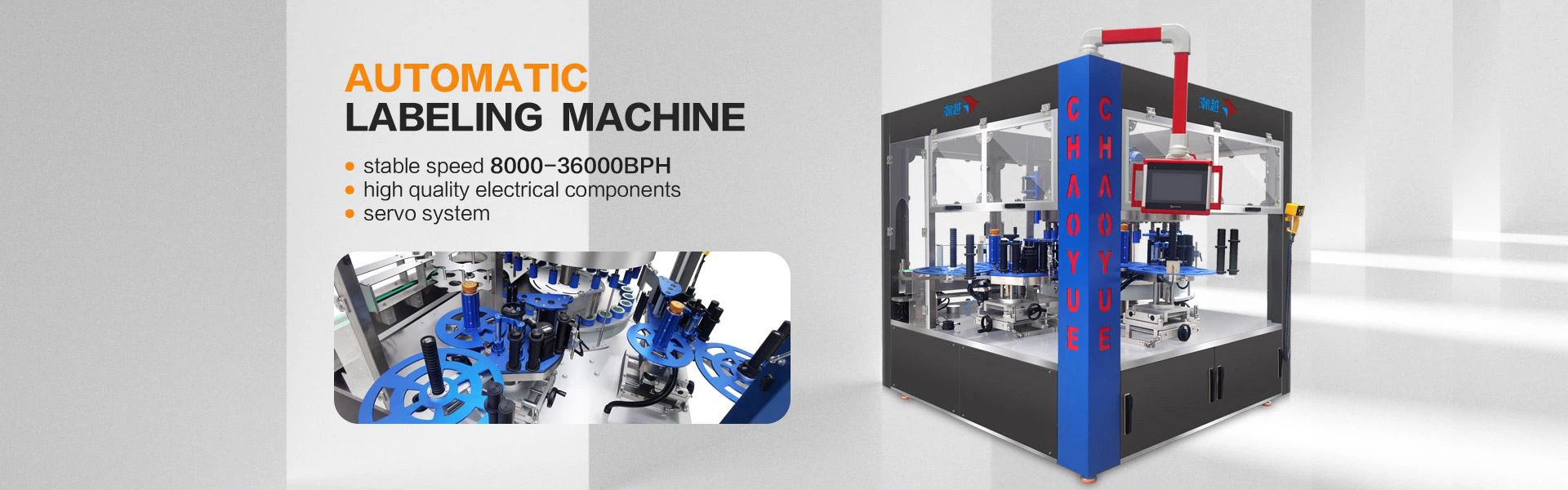

Double-Sided Square Bottle Labeling Machine
Industrial Automatic Double-Sided Square Bottle Labeling Machine
Engineering Specification Summary: Inline dual-side application system designed for flat, square, oval, and irregularly shaped containers. Achieves registration accuracy of +-1.0 mm at speeds up to 250 BPM.
Product Overview & Core Specifications
The Double-Sided Square Bottle Labeling Machine is built for high-throughput packaging environments requiring precise front and back label application on non-round containers. Unlike round bottle systems that utilize simple wrap-around rollers, square and flat containers demand positive mechanical constraint to eliminate label skew, wrinkling, and edge lifting.
Technical Parameters
|
Specification |
Standard Configuration |
Optional Customization |
|
Container Shape |
Square, Flat, Oval, Rectangular |
Custom contour pucks / nest plates |
|
Container Dimensions |
Length: 30-120 mm Width: 20-100 mm Height: 50-300 mm |
Extended range for 5L jugs |
|
Label Roll Dimensions |
Core ID: 76 mm / Outer OD: 350 mm max |
Servo-driven unwinder tension control |
|
Labeling Accuracy |
+-1.0 mm (dependent on container rigidity) |
+-0.5 mm with vision inspection |
|
Dispensing Speed |
0-40 meters/min (up to 250 bottles/min) |
High-torque servo peel assembly |
|
Power Supply |
3-Phase, 380V / 220V, 50/60Hz, 3.5 kW |
UL/CE certified electrical panel |
Product Selection Guide (How to Choose)
Selecting the correct model requires evaluating three core variables: container geometry, material tolerance, and line speed integration.
Step 1: Container Tolerances & Side Uniformity Extruded HDPE square bottles often exhibit wall thickness variations and slight concavity. If your containers deviate by more than +-1.5 mm across the body, select a model equipped with a pneumatic top-hold-down clamping conveyor rather than standard side belts to maintain vertical stability during labeling.
Step 2: Label Placement Configuration
- Synchronous Dual-Head: Applies front and back labels simultaneously. Recommended for rigid glass or thick PET bottles on high-speed dedicated lines.
- Sequential Single-Head with Flip/Transfer: Applies one side, indexes the bottle, and applies the reverse side. Ideal for space-constrained layouts or complex multi-panel wrap configurations.
Step 3: Synchronization Requirements Ensure the machine controller supports pulse-train input from your existing main conveyor encoder to prevent speed mismatch during line acceleration or deceleration.
Application & Material Compatibility
Suitable Container Materials
- Rigid PET / HDPE: Standard cosmetic and chemical containers requiring positive alignment to prevent wall deflection.
- Glass Jars & Bottles: Heavyweight pharmaceutical or food containers where thermal shock and weight necessitate high-torque, vibration-free dispensing heads.
- Aluminum / Tinplate Containers: Metal packaging requiring static discharge grounding and precise pressure calibration.
Mechanical Action & Application Process
- Container Separation: An adjustable spacing screw or dual-synchro starwheel indexes incoming bottles at a fixed pitch.
- Edge Alignment (Squaring): Pneumatic side-clamping rails or matching contour chains mechanically square the bottle against a rigid backstop, removing rotational play.
- Simultaneous Dispensing: Two independent servo-driven peeling plates release front and back labels synchronously.
- Wiping & Consolidation: Dual-stage spring-loaded brush rollers and rubber foam wiper pads execute a progressive sweep from the center outward to eliminate air pockets.
Engineering Construction & Manufacturing Standards
Chassis & Structural Frame: Fabricated from welded 304 stainless steel tubing, stress-relieved to prevent harmonic vibration at top speeds.
Drive Train: Closed-loop AC servo motors coupled directly to precision planetary gearboxes (zero backlash), eliminating belt slip common in stepper-driven alternatives.
Dispenser Peel Edge: Hard-anodized aluminum peel blades with polished 0.1 mm radii to prevent web snapping at high acceleration rates.
Electrical Architecture: PLC and HMI (Siemens / Allen-Bradley) housed in a NEMA 12 / IP54 sealed enclosure with dedicated thermal management.
Supplier Evaluation & Quality Assurance
When auditing manufacturing capabilities for automated labeling systems, verify the following factory-controlled processes:
Run-Out & Torsion Testing: Every chassis undergoes laser interferometer alignment checks to ensure drive shaft parallelism within 0.05 mm.
Factory Acceptance Testing (FAT): We perform a 72-hour continuous dry-run test followed by an 8-hour wet test utilizing client-supplied sample bottles and actual label stock.
Traceability: All pneumatic cylinders, solenoid valves (Festo/SMC), and sensors carry individual serial numbers mapped to the electrical schematic delivered with the machine.
Compliance Documentation: Systems ship with complete validation packages including IQ/OQ documentation templates, material certificates (FDA-compliant contact parts), and CE/UL wiring diagrams.
Procurement Decision & Ordering Workflow
Sample Evaluation: Send 30-50 actual containers and 1 full roll of labels to our testing lab. We evaluate grip friction, label stock tear strength, and adhesive tack.
Engineering Sign-Off: Receive a 3D integration layout drawing confirming conveyor height, direction of travel (Left-to-Right or Right-to-Left), and upstream/downstream interlocks.
Commercial Terms: Standard lead time is 35-45 days from drawing approval and deposit receipt. Factory inspection scheduled prior to final balance payment.
Commissioning & Support: Remote video-assisted installation or optional on-site engineer deployment for line integration and operator training.
Frequently Asked Questions
Q: How does the machine prevent label wrinkling on blow-molded square bottles with slight surface concavity?
A: Blow-molded square bottles frequently feature center sink marks. To counteract this, our machines utilize conforming foam-pad wiping modules paired with adjustable spring tensioners. Instead of a rigid roller that bridges a concave gap, the flexible foam adapts to the container contour, applying uniform pressure directly into the recessed center before sweeping outward to the edges.
Q: What is the format changeover time, and does it require tools?
A: A complete format changeover (adjusting guide rails, spacing screws, dispenser heights, and top-hold-down belts) takes 15 to 20 minutes. The design utilizes quick-release hand wheels, digital position indicators, and metric scale bars, eliminating the need for hand tools during routine adjustments.
Q: Can this machine integrate with existing thermal inkjet (TIJ) or laser coders?
A: Yes. The electrical cabinet includes dedicated 24VDC trigger outputs and encoder pass-through ports designed to interface directly with Domino, Videojet, Markem-Imaje, or HP-based TIJ printers for lot code and expiration date printing on the fly.
Q: What is your standard spare parts availability for international shipments?
A: High-wear components-such as rubber drive rollers, peel blades, optical product sensors, and synchronization belts-are stocked in standard metric sizes. Critical electronic components (servo drives, PLCs) are globally sourced brands (Siemens, Schneider, Omron) available locally in most industrial regions.
Technical Inquiry & Sample Testing Checklist
To initiate a precise quotation or container feasibility study, please provide the following parameters:
Container Dimensions
Length (L) x Width (W) x Height (H) in mm
Container Material
PET / HDPE / Glass / Tinplate
Label Dimensions
Width x Height, Roll Core ID, and Wind Direction
Target Line Speed
Bottles per minute (BPM) or meters per minute
Coding Integration
Do you need to mount a TIJ or laser printer? (Yes / No)
Hot Tags: double-sided square bottle labeling machine, China double-sided square bottle labeling machine suppliers, manufacturers, factory
Send Inquiry
